From the port to high-tech steel: ÖBB Rail Cargo Group and Slovenske železnice secure resilient supply chains for voestalpine
- More than three million tonnes of raw materials are transported annually via Koper (Slovenia) to voestalpine’s steel sites in Linz and Donawitz
- Construction works and capacity constraints along international corridors are making freight logistics increasingly difficult
- ÖBB Rail Cargo Group (RCG), voestalpine and Slovenske železnice (SŽ): security of supply through close cooperation
- Cross-border supply chains require European infrastructure planning, harmonised standards, simpler border procedures and greater digitalisation
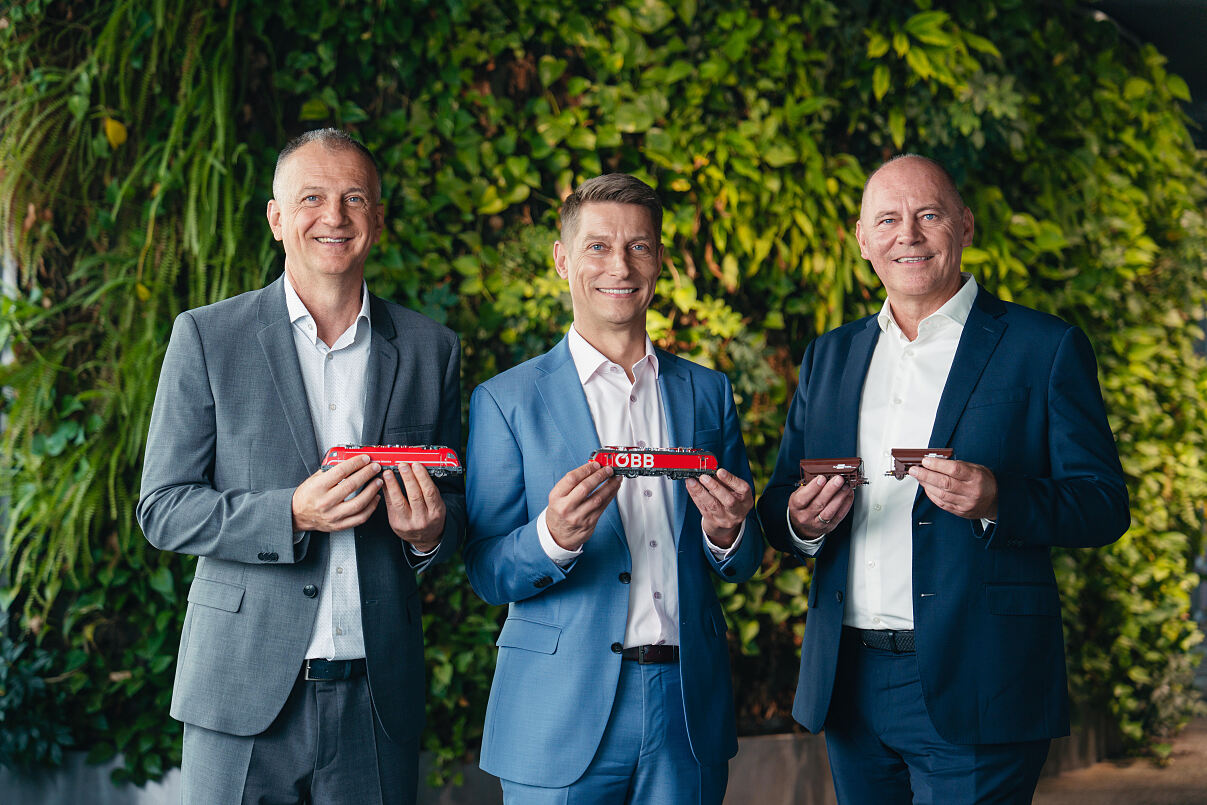
v.l.n.r. Ernest Gortan, Vorstandsvorsitzender von SŽ–Tovorni promet; Christoph Grasl, Vorstand der ÖBB Rail Cargo Group; Hubert Zajicek, Vorstandsmitglied der voestalpine AG und Leiter der Steel Division
(Vienna, 2 September 2026) – Functioning international supply chains are essential for industrial value creation, security of supply and the competitiveness of Europe as a business location. At the same time, cross-border freight logistics are becoming increasingly challenging: numerous construction sites, line closures and capacity constraints – for example, due to extreme heatwaves or international route diversions – are affecting supply chains that must operate reliably every day. The ÖBB Rail Cargo Group (RCG), voestalpine and the freight transport subsidiary of Slovenian Railways, SŽ-Tovorni promet, demonstrate how this challenge can be overcome in practice, using the example of raw material transports from the Port of Koper to voestalpine sites in Austria.
More than three million tonnes of raw materials per year
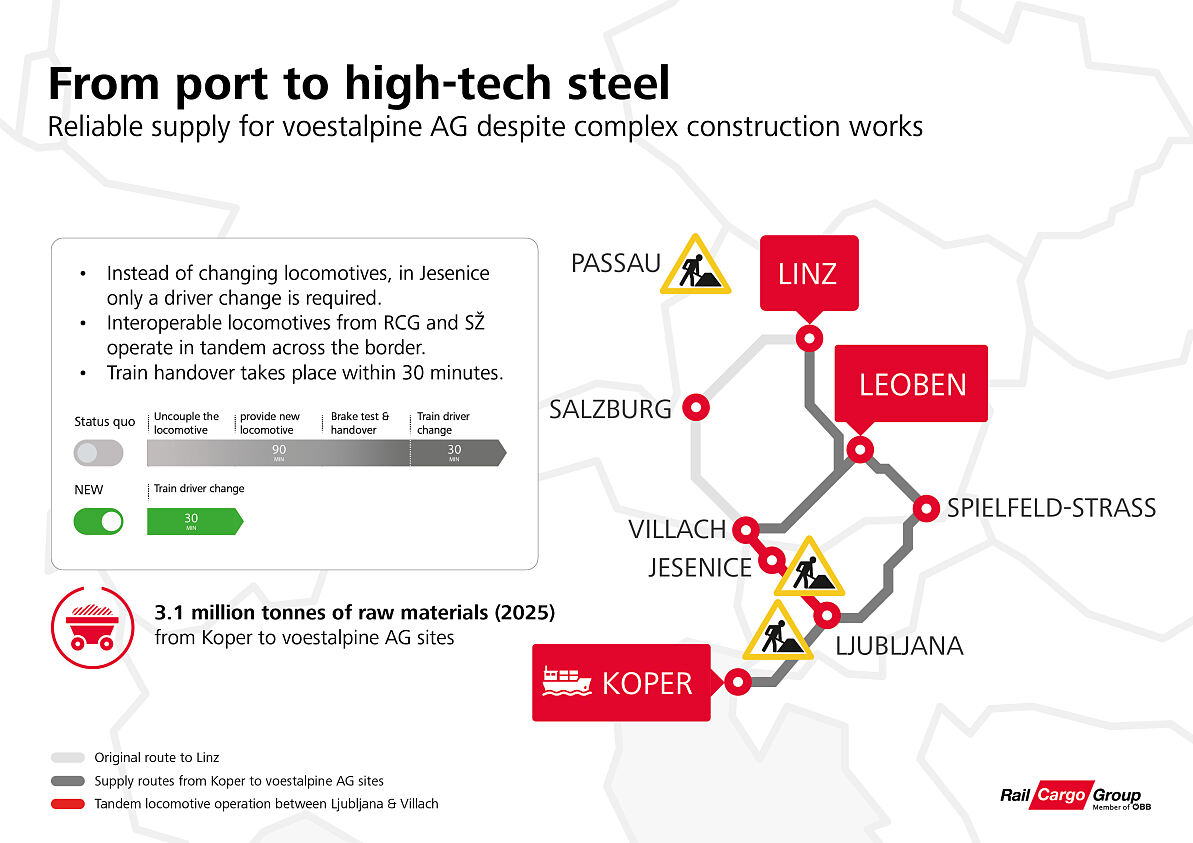
In 2025, 3.1 million tonnes were transported via the Slovenian Adriatic port of Koper to the voestalpine sites in Linz and Donawitz. In total, the ÖBB Rail Cargo Group transports around 8.5 million tonnes of raw materials for voestalpine each year – making the route via Koper one of the key elements of the raw materials supply chain. The transport of iron ore, metallurgical coal and hot briquetted iron (HBI) is handled by the ÖBB Rail Cargo Group in collaboration with SŽ – Tovorni promet. “Secure supply chains are built along the entire global logistics chain – from the port to the plant and across national borders. With our transport operations from Koper to the voestalpine sites, we demonstrate how environmentally friendly, international railway logistics – even in challenging times – safeguards industrial value creation,” emphasises Christoph Grasl, CEO of the ÖBB Rail Cargo Group.
Construction sites are putting pressure on international supply chains
Along the railway lines from Koper to Austria, there are currently several construction projects taking place simultaneously, which are slowing down railway freight transport. Restrictions are in place, amongst others, on the Koper–Divača, Brezovica–Preseje and Borovnica–Verd routes, as well as between Ljubljana and Jesenice. The Jesenice border station is also undergoing extensive modernisation. Whilst these investments are necessary to improve the long-term efficiency of the infrastructure, they pose considerable short-term challenges for the planning of international supply chains.
Stable flows of raw materials for steel production
For voestalpine, a continuous supply of materials is a key prerequisite for stable production. The steel sites in Linz and Donawitz require around 40,000 tonnes of raw materials daily. Large quantities must be reliably transported over long distances to the plants, and finished products must be transported to other customers in a similarly predictable manner. Rail plays a central role in this.
“The mere fact that we supply our sites in Linz and Donawitz with more than 15 million tonnes of raw materials per year demonstrates just how vital efficient logistics are for voestalpine. With our greentec steel transformation program, we will be taking the next major steps towards decarbonizing steel production from 2027 onwards. This transformation will also reshape our supply chains and further increase the demands placed on the transport of raw materials. A competitive European industry therefore needs resilient supply chains and strong partners throughout the entire value chain who can ensure reliable cross-border rail freight transport,” says Hubert Zajicek, member of the Executive Board of voestalpine AG and Head of the Steel Division.
Cross-border cooperation creates flexibility
To ensure that voestalpine’s transport operations continue reliably even during extensive construction work and track closures, RCG and SŽ are coordinating closely on capacities, the deployment of rolling stock and staff, and alternative routes. One example of this is the current modernisation of the Jesenice border station, which is due to be completed by September 2027. During the works, fewer tracks will be available there and trains will have to be processed much more quickly. RCG and SŽ are therefore, amongst other measures, deploying interoperable locomotives that can be used across borders. This reduces the time trains spend at Jesenice from around two hours to a maximum of 30 minutes. Alternative routes, for example via the Spielfeld-Straß border station, have also been devised for longer periods of track closure.
“It is precisely in challenging times that European railways must work even more closely together. That is what we have done together with the ÖBB Rail Cargo Group: through early coordination, flexible solutions and close operational cooperation, we have been able to reliably ensure supplies to voestalpine despite numerous construction sites and restrictions along the route. Such cooperation would not be possible without trust between partners, both on a personal level, and based on long-term cooperation,” says Ernest Gortan, CEO of SŽ–Tovorni promet.
European supply chains need European solutions
The example of transport from the Slovenian port of Koper to Austria illustrates this point: whilst international supply chains operate across borders, infrastructure planning and operational frameworks are still largely organised at national level. Construction work or capacity restrictions in one country therefore have a direct impact on the flow of goods and industrial companies in other countries.
The ÖBB Rail Cargo Group is therefore committed to more coordinated European infrastructure planning, harmonised standards, simplified border procedures and consistent digitalisation. This creates greater planning certainty for businesses, strengthens security of supply and makes railway freight transport more efficient overall. At the same time, it is an essential prerequisite for ensuring that Europe’s industry remains competitive and that the flow of goods operates sustainably and reliably.
“Running a train through Europe must be as easy as operating a truck – with harmonised processes, interoperable infrastructure, digital standards, fewer administrative hurdles and fair framework conditions for rail. As the sustainable logistical backbone of the economy, we remain fully committed to this,” emphasises RCG Board Member Christoph Grasl.
ÖBB Rail Cargo Group: the freight transport division of the ÖBB
As a leading rail logistics provider in Europe, the ÖBB Rail Cargo Group is shaping the industry. 365 days a year – 24 hours a day. Across Europe and as far as Asia. With presence in 18 countries – and own traction in 14 of them – RCG connects people, businesses and markets from the first mile to the last. 5,846 logistics professionals ensure that 407,497 freight trains per year – or 1,116 per day – safely reach their destination. In 2025, RCG generated revenues of € 2.09 billion with its efficient end-to-end logistics solutions.
The voestalpine Group
voestalpine is a globally leading steel and technology group with a unique combination of materials and processing expertise. voestalpine, which operates globally, has around 500 Group companies and locations in more than 50 countries on all five continents. The voestalpine Group has been listed on the Vienna Stock Exchange since 1995. With its premium products and system solutions, voestalpine is a leading partner to the automotive and machinery industries, as well as to the aerospace and energy industries. The company is also the global market leader in railway systems and special sections. voestalpine is committed to the global climate goals and has a clear plan for transforming steel production with its greentec steel program. In the business year 2025/26, the Group generated revenue of EUR 15.1 billion, with an operating result (EBITDA) of EUR 1.5 billion; it has around 48,800 employees worldwide.
SŽ-Tovorni promet: the freight transport company of Slovenske železnice
SŽ Tovorni promet is a provider of cargo transport and advanced logistics solutions in Slovenia and abroad. It is one of the key operators in the region, ensuring fast, competitive, and reliable transport of a wide range of cargo groups in conventional and combined transport.
With its own traction in Slovenia, Croatia and Austria and a wide network of long-standing partner carriers, SŽ-Tovorni promet helps build efficient supply chains for many successful companies in Slovenia and the wider region, supporting their growth.
6 708 x 4 472
©
ÖBB Leonte
From port to high-tech steel: ÖBB Rail Cargo Group and Slovenske železnice secure raw material supply for voestalpine
v.l.n.r. Ernest Gortan, Vorstandsvorsitzender von SŽ–Tovorni promet; Christoph Grasl, Vorstand der ÖBB Rail Cargo Group; Hubert Zajicek, Vorstandsmitglied der voestalpine AG und Leiter der Steel Division
©
ÖBB Leonte
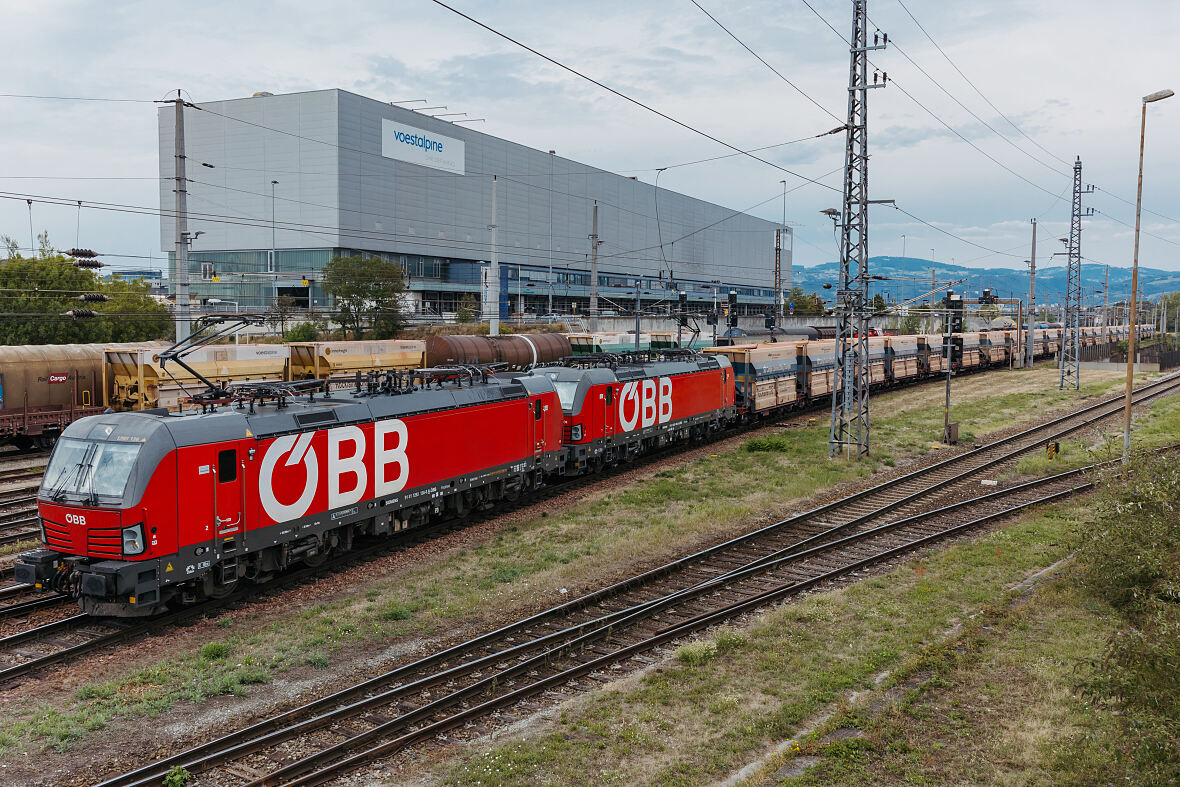
RailCargo
RailCargo
©
ÖBB
Infographic
Infographic
©
ÖBB
ÖBB. Today. Tomorrow. Together.
ÖBB has been shaping mobility for over 100 years. As a comprehensive mobility and logistics service provider, ÖBB transported 559 million passengers and around 79 million tonnes of goods to their destinations in 2025. This is because 100% of the electrical power for ÖBB trains and stations comes from renewable energy. With 94.1 percent punctuality in passenger transport in 2025, ÖBB is one of the most punctual railways in Europe. With capital expenditure of around four billion euros annually in the railway infrastructure and fleet (2027-32 framework plan), ÖBB is building the railway system of the future. Across the Group, more than 48,000 bus and rail employees and around 2,145 apprentices ensure that more than 1.5 million passengers reach their destinations safely every day. ÖBB is the backbone of public transport and brings people and goods to their destinations reliably. ÖBB-Holding AG is the Group's strategice management company.